Artificial intelligence (AI): When hearing the word Artificial intelligence people often think about platforms that respond to your questions for instance Open-AI’s ChatGPT, Google’s Gemini and many more but AI is more than that, more than responding to your questions. So today we will be seeing some of the features of this field.
Firstly what is AI itself?
Artificial intelligence(AI): is a broad field of computer science concerned with designing and running intelligent computer systems. When we say intelligence there are two main types of intelligence but wait they are not two, but for now, we will only be seeing two of them. Natural intelligence(NI) is the ability to think, observe, understand, categorise, manipulate and make decisions. This type of intelligence is only for humans. To sum up, the main purpose of AI is to give computers and machines the ability to think, observe, understand, categorise, manipulate and make decisions on their behalf.
What are the types of AI?
Artificial intelligence(AI) can be categorised depending on its capabilities and functionalities. What are the types of AI based on its capabilities.
Narrow (Weak) AI: this is the type of AI we mentioned earlier these AI systems are designed to perform specific and simple sets of tasks. Virtual assistants like Siri, Gemini and Alexa are the best examples of Narrow or Weak AI. Even if they don’t perform tasks out of a specific domain they are brilliant systems.
General (Strong) AI: As we predict from the name these types of systems have the ability to learn, understand and apply intelligence across a wide range of areas, much like humans. General (Strong) AI can perform any task that humans can do. In today’s world, these types of AI systems don’t exist.
Super AI: An advanced form of AI that can surpass human intelligence in creativity, decision making and different abilities. Super AI is in a stage of fictional theory let alone becoming a reality.
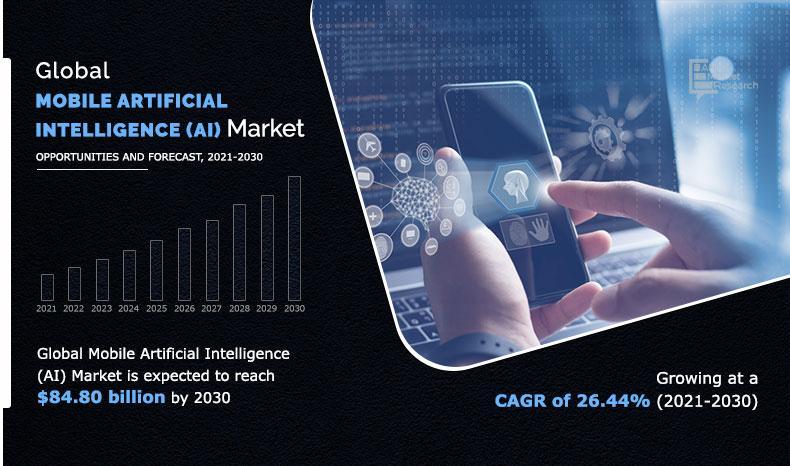
Allied Market Research (AMR) has published a new report on the mobile artificial intelligence market. According to the report, the global market is anticipated to gain a value of $84.80 billion by 2030, having endorsed a value of $8.56 billion in 2020. The industry’s CAGR is estimated to be 26.44% during the forecast period (2021-2030). The research report is a valuable resource containing detailed information on the overall market, including market dynamics, prominent investment opportunities, pricing factors, key trends, segmentation, regional analysis, and the competitive landscape.
The report also presents an overview of the key players in the global mobile artificial intelligence industry, conducting a thorough analysis of the current situation and future growth opportunities. Utilizing insightful graphs, it showcases market profitability and offers an in-depth SWOT analysis of industry trends. Furthermore, the report provides valuable information on regional expansion.
𝐔𝐧𝐝𝐞𝐫𝐬𝐭𝐚𝐧𝐝𝐢𝐧𝐠 𝐌𝐚𝐫𝐤𝐞𝐭 𝐃𝐲𝐧𝐚𝐦𝐢𝐜𝐬
The research report provides a comprehensive analysis of market dynamics, covering aspects such as drivers, restraints, and opportunities. These insights enable businesses and stakeholders to engage in strategic planning, manage risks, and identify growth opportunities, thus helping in the achievement of business goals. The global mobile artificial intelligence market is expanding rapidly due to a significant demand for artificial intelligence (AI) in smartphones, an increasing need for AI-enabled processors, and a steady rise in investment in AI technologies. However, the high cost of artificial processors has restricted market growth to some extent. Moreover, the increasing prominence of edge computing offers profitable opportunities for industry growth in the coming years.
𝐊𝐞𝐲 𝐃𝐞𝐯𝐞𝐥𝐨𝐩𝐦𝐞𝐧𝐭𝐬 𝐢𝐧 𝐭𝐡𝐞 𝐈𝐧𝐝𝐮𝐬𝐭𝐫𝐲
AI has indeed made notable growth in the landscape of mobile app development services. Nowadays, developers are using various technologies to enhance user experience and introduce novel features. Some key AI technologies being utilized for these purposes include:
𝐌𝐚𝐜𝐡𝐢𝐧𝐞 𝐥𝐞𝐚𝐫𝐧𝐢𝐧𝐠 (𝐌𝐋)
This subset of AI enables apps to analyze data, recognize patterns, and make predictions or decisions independently, without explicit coding. Moreover, services such as Netflix and Spotify utilize machine learning to provide users with personalized recommendations based on their viewing or listening habits, as well as individual preferences.
This technology allows apps to recognize and analyze images and videos using advanced methods. For example, Pinterest Lens, Google Lens, and Bixby Vision all utilize computer vision for tasks such as visual search, object recognition, and virtual reality interactions.
𝐍𝐚𝐭𝐮𝐫𝐚𝐥 𝐥𝐚𝐧𝐠𝐮𝐚𝐠𝐞 𝐩𝐫𝐨𝐜𝐞𝐬𝐬𝐢𝐧𝐠 (𝐍𝐋𝐏)
NLP enables apps to comprehend, translate, and generate human language. Virtual assistants such as Google Assistant, Siri, and Alexa utilize NLP to understand vocal commands and engage in conversations in mobile applications.
𝐑𝐞𝐠𝐢𝐨𝐧𝐚𝐥 𝐀𝐧𝐚𝐥𝐲𝐬𝐢𝐬
The global mobile artificial intelligence industry is examined across several regions, including North America, Latin America, Asia-Pacific, the Middle East & Africa, and Europe. The market in North America garnered the largest share in 2020 and is anticipated to maintain its leading position throughout the forecast period. This is attributed to the region providing a hassle-free environment for small and medium-sized enterprises (SMEs), especially concerning compliance with government regulations. On the other hand, Asia-Pacific is predicted to showcase an outstanding CAGR over the projected period due to a notable rise in the adoption and integration of AI technologies on mobile devices in the area.
The global mobile artificial intelligence market is fragmented due to many key players around the world. Artificial intelligence comprises complex algorithms that are rapidly growing in the current market. AMR’s report has analyzed that several top companies are now adopting readily available artificial intelligence algorithms for complex systems, leading to high competition in the market. For example, in January 2024, Apple launched iOS 16.3 which introduced Focus Filters. These filters enable users to customize app access based on different Focus modes such as work or personal.
However, in February 2024, Google Assistant introduced “Custom Routines,” which allows users to customize routines according to their behaviors and preferences. For instance, users can say “Good morning” to activate tasks such as turning on lights, playing music, and checking the news.
𝐊𝐞𝐲 𝐂𝐨𝐦𝐩𝐚𝐧𝐢𝐞𝐬 𝐏𝐫𝐨𝐟𝐢𝐥𝐞𝐝 𝐢𝐧 𝐭𝐡𝐞 𝐌𝐚𝐫𝐤𝐞𝐭 𝐑𝐞𝐩𝐨𝐫𝐭
• Google LLC (Alphabet Inc.)
• MediaTek Inc.
• Samsung Electronics
• International Business Machines Corporation (IBM)
• Intel Corporation
• Qualcomm Technologies, Inc.
• Apple Inc.
• NVIDIA Corporation
• Huawei Technologies Co., Ltd.
• Microsoft Corporation
To sum up, the AMR report explores the global mobile artificial intelligence market, providing a detailed analysis of growth drivers, top investment opportunities, recent developments, and regional analysis. By offering insightful data and analysis, the report is a valuable resource for businesses and stakeholders looking to understand the market dynamics and make well-informed decisions.
Allied Market Research is a top provider of market intelligence that offers reports from leading technology publishers. Our in-depth market assessments in our research reports take into account significant technological advancements in the sector. In addition to other areas of expertise, AMR focuses on the analysis of high-tech systems and advanced production systems. We have a team of experts who compile thorough research reports and actively advise leading businesses to enhance their current procedures. Our experts have a wealth of knowledge on the topics they cover. Also, they use a variety of tools and techniques when gathering and analyzing data, including patented data sources.
“Just saying ‘AI’ 15 times is not going to cut it anymore.”
So said Stuart Kaiser, head of U.S. equity trading strategy at Citi, speaking to the Financial Times (FT) Wednesday (June 19) about the state of artificial intelligence (AI) investments.
As that report noted, most of the stocks that jumped amid last year’s AI hype have dropped this year, a sign that investors could be growing more selective in backing companies that claim to benefit from the rise of artificial intelligence.
According to the FT, huge rallies by firms like Nvidia — now the most valuable public company in the world — have triggered a debate about whether the U.S. stock market is being fueled by speculative hype.
“AI is still a big theme, but if you can’t demonstrate evidence, you’re getting hurt,” said Kaiser.
The report said around 60% of stocks in the S&P 500 have gone up this year, but more than half the stocks included in Citi’s “AI Winners Basket” have declined. Last year, more than 75% of companies in that group had risen.
“Investors are looking a bit more at the earnings story among ‘AI’ names,” Mona Mahajan, senior investment strategist at Edward Jones, told the FT. “The differentiator with something like a Nvidia is they have delivered on the bottom line, showing real data.”
Elsewhere on the AI front, PYMNTS wrote Tuesday (June 18) about a problem vexing businesses: AI systems that confidently offer up plausible but inaccurate information, a phenomenon often referred to as “hallucinations.”
As companies increasingly depend on AI for decision-making, the risks presented by these fabricated outputs are coming into greater focus. At the heart of the issue are large language models (LLMs), the AI systems behind much of the newest tech businesses are adopting.
“LLMs are built to predict the most likely next word,” Kelwin Fernandes, CEO of NILG.AI, a company specializing in AI solutions, told PYMNTS. “They aren’t answering based on factual reasoning or understanding but on probabilistic terms regarding the most likely sequence of words.”
This dependence on probability means that if the training data used to develop the AI is flawed or the system misunderstands a query’s intent, it can create a response that is confidently delivered but still inaccurate — a hallucination.
“While the technology is evolving rapidly, there still exists a chance a categorically wrong outcome gets presented,” Tsung-Hsien Wen, CTO at PolyAI, told PYMNTS.
Nvidiahastaken the lead as three companies race to hold the title of the world’s most valuable company.
The chipmaker overtook Microsoft and Apple on Tuesday (June 18) as its shares rose as much as 4% and its market capitalization reached about $3.3 trillion, Bloomberg reported Tuesday.
The three companies have been changing positions among the world’s three most valuable companies over the past month, according to the report.
All three have been driven by the wave of investor interest in artificial intelligence (AI), the report said.
Nvidia’s gains are driven by its status as the dominant maker of chips that help power data centers that run the computing tasks needed by AI applications, per the report.
Microsoft has benefited from its investment and partnership with OpenAI, while Apple’s shares surged this week after it made its long-awaited announcement of its plans for AI, according to the report.
Daniel Ives, analyst andWedbush Securities, wrote in a note, per the report: “We believe over the next year the race to $4 Trillion Market Cap in Tech will be front and center between Nvidia, Apple and Microsoft.”
In Nvidia’s most recent earnings release, the chipmaker said its revenue for the quarter ended April 28 was up 18% compared to the previous quarter and up 262% from the same period a year earlier, reaching $26 billion.
The company’s sales beat Wall Street expectations and even its own outlook for the quarter, which had been $24 billion.
Nvidia Founder and CEO Jensen Huang said in the earnings release that the company’s revenue growth was driven by companies and countries partnering with the chipmaker to transition from their traditional data centers to “AI factories” that will deliver productivity gains in many industries.
On Friday (June 14), Nvidia unveiled a family of open models that generate synthetic data for training large language models (LLMs) across various industries.
On June 2, the company said it will debut a next-generation AI platform called Rubin in 2026 and will update its AI accelerators each year, with the Blackwell Ultra chip due in 2025.
When announcing those products, Huang said he expects more and more companies and government agencies to embrace generative AI.
For all PYMNTS AI coverage, subscribe to the daily AI Newsletter.
Snapchat parent company Snap has launched new generative artificial intelligence (AI) tools that helps users create augmented reality (AR) effects.
These tools will enable artists and developers to create AR effects in hours rather than weeks, Reuters reported Tuesday (June 18), citing its interview with Snap Chief Technology Officer Bobby Murphy.
Snap’s new additions include: tools that help AR developers create AI-powered lenses that Snapchat users can then add to their content; an AI assistant that will answer developers’ questions; a tool that enables artists to create three-dimensional images by simply typing prompts; and tools that build more realistic lenses that match the motion and lighting of the content they are added to, according to the report.
Snap CEO Evan Spiegel said in April that the company believes that AR will be “one of the most meaningful advancements in computing that the world has ever seen.”
The company’s AR tools are used by advertisers to create a more exciting shopping experience with virtual storefronts and try-on experiences. They are also used by creators to drive monetization opportunities and by platform users to play with lenses, Spiegel said April 25 during the company’s quarterly earnings call.
“Our AR products and services are driving major impact at scale today,” Spiegel said. “On average, over 300 million people engage with augmented reality every single day on Snapchat. Our community plays with AR Lenses billions of times per day on average, and our AR creator community has built millions of Lenses using our Lens Studio software.”
In May, Spiegel said Snap is increasing its spending on AI and machine learning (ML) to meet the needs of advertisers who are trying to drive immediate purchases on the social media platform with the help of ML, AI and AR features.
Other companies, too, are adopting AI and AR tools to power features that do things like help consumers determine their clothing size when buying online and choose the products they like the most with the aid of virtual try-on tools.
AR try-on is also being used by sellers of beauty products to help bridge the trust gap for online shoppers.
AI n Computer Vision Market Size, Share, Growth Analysis, By Application(Industrial (2D Machine Vision, 3D Machine Vision, Quality Assurance & Inspection), Non-industrial), By Component(Software (AI Platform, AI Solution), Hardware (Processor [CPU, GPU), By Function(Training, Interference), By Machine Learning Models(Supervised Learning (Convolutional Neural Networks, Recurrent Neural Networks), Unsupervised Learning, Reinforcement Learning), By End Use Industry
Artificial Intelligence (AI) in Computer Vision Market [https://www.skyquestt.com/report/ai-in-computer-vision-market] size was valued at USD 20.7 billion in 2022 and is poised to grow from USD 25.8 billion in 2023 to USD 148.8 billion by 2031, growing at a CAGR of 24.5% during the forecast period (2024-2031).
Global artificial intelligence (AI) in the computer vision market serves several purposes, including improving security systems for monitoring and access control. Furthermore, they have a part in using facial recognition technology to unlock smartphones and other gadgets. Computer vision also plays a crucial role in identifying individuals in images and videos by using facial recognition software. Moreover, to analyze visual data and personalize the experiences that users have on social networking sites or adverts, computer vision is applied. The application of computer vision systems has been extended into various industries due to advances made in terms of image sensors, advanced cameras and deep learning techniques.
Niche AI Firms Challenge Tech Giants in a Booming Market
Alongside specialised AI companies, well-known IT behemoths like Intel, Microsoft, Nvidia, and IBM are fighting for supremacy in the dynamic global AI in computer vision market. While certain players focus on specific uses, such technology giants utilize their strong bases in hardware and software. This strengthens the rivalry since cloud-service providers like Amazon, Google are attracting companies that want to use scalable solutions derived from their robust AI frameworks. The combination of well-established firms, quick-thinking AI experts, and massive cloud providers creates a competitive environment where success depends on innovation and smart alliances.
Hardware and Software Investments of Leading AI Vision Players
Global leaders in artificial intelligence for computer vision, such as Nvidia, Intel, Microsoft, and IBM, are at the forefront of the industry. These industry giants use their massive financial resources to invest in cutting-edge hardware like Intel’s AI processors and Nvidia’s Graphics Processing Units (GPUs), which are used to drive complex computer vision algorithms.
Microsoft and IBM, meanwhile, make contributions with their strong software frameworks and research capabilities. Their large investments support innovation in fields such as image analysis, object identification, and facial recognition, thereby establishing them as key players in determining the direction of computer vision.
Examining the Diverse Strengths of Nvidia and Microsoft
Consider Nvidia as an example. Sophisticated computer vision algorithms use their high-performing GPUs to harness processing power, just like Tesla series as their driving motors. These powerful chips are great in performing multiple tasks at the same time, thus enhancing quick image and video analysis. In contrary, Microsoft avails pre-constructed AI vision technologies on its Azure Cognitive Services package that runs on the internet. This saves developers from having to start from scratch when integrating capabilities like object detection and facial recognition into their apps. This combination of Nvidia’s hardware and Microsoft’s easily navigable software clearly demonstrated the numerous benefits that are propelling the AI computer vision.
Explosive Growth Fuelled by Personalized Experiences and Innovation
Computer vision applications are transforming several industries, from using facial recognition to improve security systems to analysing social media data for targeted advertising. Advances in cameras, sensors and deep learning algorithms have pushed its boundaries. The changing landscapes are not confined to it. Majorly, Intel and Nvidia have employed their hardware prowess. However, specific application areas are where agile AI gurus place their focus. Also, Google and Amazon- cloud behemoths are launching powerful AI frameworks. Strategic alliances and ongoing innovation are essential to dominate in this competitive environment created by the interaction of established players, creative specialists, and cloud providers.
In an impressive collaboration, researchers at Harvard University have joined forces with Google DeepMind scientists to create an artificial brain for a virtual rat. Published in Nature, this innovative breakthrough opens new doors in studying how brains control complex movement using advanced AI simulation techniques.
Building the Virtual Rat Brain
To construct the virtual rat’s brain, the research team utilized high-resolution data recorded from real rats. The Harvard researchers worked closely with the DeepMind team to build a biomechanically realistic digital model of a rat. Graduate student Diego Aldarondo collaborated with DeepMind researchers to train an artificial neural network (ANN), which serves as the virtual brain, using the powerful machine learning technique deep reinforcement learning.
The neural network was trained to use inverse dynamics models, which are believed to be employed by our brains for guiding movement. These models enable the brain to calculate the necessary trajectory and translate it into motor commands for achieving a desired motion, such as reaching for a cup of coffee. The virtual rat’s neural network learned to generate the required forces to produce a wide range of behaviors, including those not explicitly trained, by using reference trajectories derived from real rat data.
As Ölveczky noted, “DeepMind had developed a pipeline to train biomechanical agents to move around complex environments. We simply didn’t have the resources to run simulations like those, to train these networks.” The collaboration was “fantastic,” he added, emphasizing the crucial role played by the DeepMind scientists in realizing this breakthrough.
The result is a virtual brain capable of controlling a biomechanically realistic 3D rat model within a sophisticated physics simulator, closely mimicking the movements of a real rodent.
Potential Applications
The virtual rat with its artificial brain presents a novel approach for probing the neural circuits responsible for complex behaviors. By studying how the AI-generated brain controls the virtual rat’s movements, neuroscientists can gain valuable insights into the intricate workings of real brains.
This breakthrough could also pave the way for engineering more advanced robotic control systems. As Ölveczky suggests, “While our lab is interested in fundamental questions about how the brain works, the platform could be used, as one example, to engineer better robotic control systems.” By understanding how the virtual brain generates complex behaviors, researchers may be able to develop more sophisticated and adaptive robots.
Perhaps most excitingly, this research may enable a new field of “virtual neuroscience,” where AI-simulated animals serve as convenient and fully transparent models for studying the brain, even in disease states. These simulations could provide an unprecedented window into the neural mechanisms behind various neurological conditions, potentially leading to new treatment strategies.
Next Step: More Virtual Rat Autonomy
Building upon this groundbreaking work, the researchers plan to give the virtual rat more autonomy to solve tasks akin to those encountered by real rats. As Ölveczky explains, “From our experiments, we have a lot of ideas about how such tasks are solved, and how the learning algorithms that underlie the acquisition of skilled behaviors are implemented.”
By granting the virtual rat more independence, the scientists can test their theories about the learning algorithms that enable the acquisition of new skills. This could provide valuable insights into how real brains learn and adapt to new challenges.
Ultimately, the goal is to advance our understanding of how real brains generate complex behavior. “We want to start using the virtual rats to test these ideas and help advance our understanding of how real brains generate complex behavior,” Ölveczky states. By continuing to refine and expand upon this innovative approach, neuroscientists and AI researchers can work together to unravel the mysteries of the brain and create more intelligent, adaptable systems.
In an address to the G7 summit, Pope Francis discusses the threat and promise of artificial intelligence, the ‘techno-human condition’, human vs algorithmic decision-making, AI-written essays, and the necessity of political collaboration on technology.
He is the first Pope to ever address the forum, which brings together the leaders of the US, UK, Italy, France, Canada, Germany, and Japan.
AI: Dangers and promises
The Pope dedicated his address to the G7 to the subject of artificial intelligence.
He began by saying that the birth of AI represents “a true cognitive-industrial revolution” which will lead to “complex epochal transformations”.
These transformations, the Pope said, have the potential to be both positive – for example, the “democratization of access to knowledge”, the “exponential advancement of scientific research”, and a reduction in “demanding and arduous work” – and negative – for instance, “greater injustice between advanced and developing nations or between dominant and oppressed social classes.”
Pope Francis greets G7 leaders
The ’techno-human condition’
Noting that AI is “above all a tool”, the Pope spoke of what he called the “techno-human condition”.
He explained that he was referring to the fact that humans’ relationship with the environment has always been mediated by the tools that they have produced.
Some, the Pope said, see this as a weakness, or a deficiency; however, he argued, it is in fact something positive. It stems, he said, from the fact that we are beings “inclined to what lies outside of us”, beings “radically open to the beyond.”
This openness, Pope Francis said, is both the root of our “techno-human condition” and the root of our openness to others and to God, as well as the root of our artistic and intellectual creativity.
The Pope speaking to the G7
Decision-making: humans v machines
The Pope then moved on to the subject of decision-making.
He said that AI is capable of making “algorithmic choices” – that is, “technical” choices “among several possibilities based either on well-defined criteria or on statistical inferences”.
Human beings, however, “not only choose, but in their hearts are capable of deciding.”
This is because, the Pope explained, they are capable of wisdom, of what the Ancient Greeks called phronesis (a type of intelligence concerned with practical action), and of listening to Sacred Scripture.
It is thus very important, the Pope stressed, that important decisions must “always be left to the human person.”
As an example of this principle, the Pope pointed to the development of lethal autonomous weapons – which can take human life with no human input – and said that they must ultimately be banned.
Algorithms ‘neither objective nor neutral’
The Pope also stressed that the algorithms used by artificial intelligence to arrive at choices are “neither objective nor neutral.”
He pointed to the algorithms designed to help judges in deciding whether to grant home-confinement to prison inmates. These programmes, he said, make a choice based on data such as the type of offence, behaviour in prison, psychological assessment, and the prisoner’s ethnic origin, educational attainment, and credit rating.
However, the Pope stressed, this is reductive: “human beings are always developing, and are capable of surprising us by their actions. This is something that a machine cannot take into account.”
A further problem, the Pope emphasised, is that algorithms “can only examine realities formalised in numerical terms:”
The Pope addresses the G7
AI-generated essays
The Pope then turned to consider the fact that many students are increasingly relying on AI to help them with their studies, and in particular, with writing essays.
It is easy to forget, the Pope said, that “strictly speaking, so-called generative artificial intelligence is not really ‘generative’” – it does not “develop new analyses or concepts” but rather “repeats those that it finds, giving them an appealing form.”
This, the Pope said, risks “undermining the educational process itself”.
Education, he emphasised, should offer the chance for “authentic reflection”, but instead “runs the risk of being reduced to a repetition of notions, which will increasingly be evaluated as unobjectionable, simply because of their constant repetition.”
Towards an “algor-ethics”
Bringing his speech to a close, the Pope emphasised that AI is always shaped by “the worldview of those who invented and developed it.”
A particular concern in this regard, he said, is that today it is “increasingly difficult to find agreement on the major issues concerning social life” – there is less and less consensus, that is, regarding the philosophy that should be shaping artificial intelligence.
What is necessary, therefore, the Pope said, is the development of an “algor-ethics”, a series of “global and pluralistic” principles which are “capable of finding support from cultures, religions, international organizations and major corporations.”
“If we struggle to define a single set of global values,” the Pope said, we can at least “find shared principles with which to address and resolve dilemmas or conflicts regarding how to live.”
The Pope listens to another G7 intervention
A necessary politics
Faced with this challenge, the Pope said, “political action is urgently needed.”
“Only a healthy politics, involving the most diverse sectors and skills”, the Pope stressed, is capable of dealing with the challenges and promises of artificial intelligence.
The goal, Pope Francis concluded, is not “stifling human creativity and its ideals of progress” but rather “directing that energy along new channels.”
You can find the full text of the Pope’s address to the G7 here.
The technology giant Apple announced this Monday its own free artificial intelligence (AI) for its products, which will be called ‘Apple Intelligence’, as well as the union with OpenAI so that its assistant Siri can access ChatGPT to respond to its users’ responses. users later this year.
The CEO of the company with the bitten apple, Tim Cook, stressed this Monday at the WWDC developers conference that Apple’s AI will be “indispensable for his company’s products,” as it will make them “more useful and pleasant.”
Although the company has been using AI for years, until now Apple preferred not to use this term, but given the speed shown by its competitors Google and Microsoft to join this technology, and given its good results on the stock market, today Apple dove into this wave.
To do this, the titan joined OpenAI, just like Microsoft did last year. Later this year, Apple will allow Siri to access GPT-4o, OpenAI’s most advanced chatbot, to answer user questions.
Ultimately, however, it will be up to users to decide if they want their questions to be shared with ChatGPT.
Beyond having access to the popular chatbot, Apple’s AI will power Siri so that you can perform actions within and between iOS 18 applications, such as sending an article to a group in message, or saving an address to a contact simply by ‘viewing it. “ on the screen.
‘Apple Intelligence’ will also extend to Apple tablets and computers.
Some of the qualities of this technology noted by Craig Federighi, vice president of software engineering, include the ability of ‘Apple Intelligence’ to recognize which notifications are important to notify the user when they have the ‘do not disturb’ mode.
As well as using this AI to write or summarize texts, edit photos or create images and animations based on the user’s photo library, something that several AI models already offer.
iOS 18 Announcement Apple also showed the next software update for the iPhone, iOS 18, which thanks to AI offers users greater ‘customization’.
Federighi showed a series of new improvements — powered by AI — such as greater personalization for the home screen, in text messages, in emails and photos.
As well as more privacy, since users will be able to block applications if they do not want third parties to access their information.
One of the new features for iPad in iPadOS 18 is “calculator math notes,” a feature in which users can write a math problem on the tablet and obtain the result by entering the ‘equals’ symbol.
While one of the main new features of macOS 15 Sequoia, for Mac, is the function to “duplicate” an iPhone, to access an iPhone from a Mac.
New model of virtual reality glasses The apple company also announced a new model of its Vision Pro virtual reality glasses, VisionOS 2, four months after launching its first model on the market.
Some of the updates to the glasses are the use of AI to transform normal photographs into “space photographs” — in three dimensions — that are compatible with Vision Pro, as well as the ability to see through the glasses an ultra-wide screen that , according to Apple, is equivalent to two 4K monitors side by side.
The price of this new model was not mentioned. The first model (Vision Pro) is currently sold only in the United States, at a price of $3,499.
Apple Vice President Mike Rockwellsi announced that Vision Pro will be available in China, Japan and Singapore from June 28 and in Australia, Canada, France, Germany and the United Kingdom from July 12. He did not give dates for the sale of VisionOS 2.
The global artificial intelligence (AI) landscape is undergoing significant shifts as regulators grapple with the technology’s rapid advancements.
While the U.S. and Europe are considering tightening AI regulations, Argentina President Javier Milei is positioning his country as a potential haven for tech investments. Meanwhile, the U.S. legal system is treading cautiously, with federal appeals courts hesitating to adopt AI-related rules.
Various industry leaders are also urging the U.S. Food and Drug Administration (FDA) to strike a balance in its approach to AI regulation in the pharmaceutical and medical device sectors.
Regulatory Shifts May Drive AI Investment to Argentina
After six months in office, President Milei is capitalizing on global regulatory shifts to position Argentina as the world’s fourth AI hub. Milei’s economic adviser, Demian Reidel, has highlighted Argentina’s potential as a strategic destination for tech investments, given the increasing regulatory pressures in the U.S. and Europe, according to a report by the Financial Times.
Reidel, who orchestrated Milei’s recent meetings with tech giants like OpenAI, Google, Apple and Meta, said restrictive regulations in other regions are making Argentina an attractive alternative.
“Extremely restrictive” rules have “killed AI in Europe,” Reidel said. He added that discussions in the U.S., particularly in California, indicated that American lawmakers might follow a similar path, further driving companies to seek more favorable environments.
In May, Milei and Reidel held private meetings in California with key industry figures, including OpenAI’s Sam Altman and Apple’s Tim Cook. They also hosted a summit with AI investors and thinkers, such as venture capitalist Marc Andreessen and sociologist Larry Diamond. Additionally, Milei has met with Tesla CEO Elon Musk twice.
Court Case? Better Bring a Human
In a move that could have set a digital precedent, the 5th U.S. Circuit Court of Appeals in New Orleans decided to keep its courtrooms strictly human for now. The court opted not to adopt what would have been the nation’s first rule regulating the use of generative AI by lawyers, Reuters reported Tuesday (June 11).
The proposed rule, introduced last November, sought to mandate that attorneys who used AI-generated filings — courtesy of tools like OpenAI’s ChatGPT — would certify that the documents had been thoroughly reviewed for accuracy. Missteps in compliance could have led to sanctions or the striking of the errant documents from court records.
The court’s decision came after an influx of public commentary, mostly from skeptical lawyers. The legal community voiced concerns over AI’s reliability, citing incidents where AI “hallucinations” resulted in fictitious case citations.
Had the 5th Circuit moved forward, it would have been the only court among the 13 federal appeals courts with such a rule. Other federal appeals courts are also toying with the idea of AI regulations, echoing the 5th Circuit’s concerns.
Across the pond, a recent survey by Thomson Reuters showed that U.K. lawyers are divided on AI regulation: 44% of in-house lawyers want government oversight, while 50% prefer self-regulation. Law firms echo this split, with 36% favoring regulation and 48% opting for a laissez-faire approach, leaving regulators in a bind.
Experts Urge FDA to Strike Balance in AI Regulation
Industry leaders at the RAPS Regulatory Intelligence Conference emphasized the need for a balanced approach in the FDA’s future AI regulations, advocating for flexibility and collaboration over rigid rules, Regulatory News reported Monday (June 10).
The panel stressed the importance of clearly defining AI goals within the pharmaceutical and medical device industries. Bayer’s use of AI was highlighted as an example of integrating AI into medical devices and regulatory intelligence. Merck’s AI tools and pilot projects were also noted, with an emphasis on the need for vendor partnerships due to current technology limitations.
The potential of AI to analyze vast amounts of data pointed to the untapped data that could streamline regulatory processes, Thompson noted.
Opinions on AI’s readiness varied among the panelists.
Some expressed skepticism about AI’s current capabilities and advised against large investments without clear objectives, noting that companies often fail within months due to poor planning. However, others were more optimistic, highlighting AI’s ability to accelerate product development while cautioning that it is just the first step and requires further refinement.
The panel concluded with a consensus that precise goals and strategic investments are crucial for leveraging AI’s full potential in the pharmaceutical and medical device sectors while effectively navigating the regulatory landscape.